

UPC: 5020393302326
Format: CD
Release Date: May 10, 1999
Regular price
$18.95 USD
Regular price
Sale price
$18.95 USD
Unit price
per
Couldn't load pickup availability
FREE SHIPPING
This item is currently out of stock and may be on backorder.
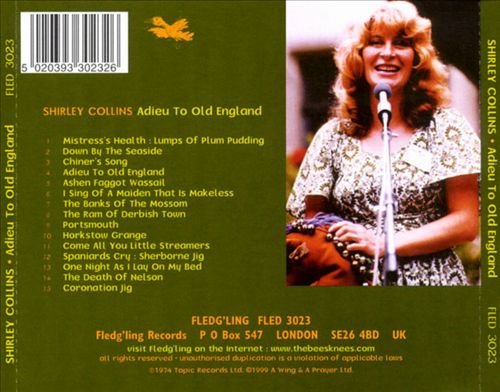
Personnel includes: Shirley Collins (vocals); Simon Nicol.
Personnel: Shirley Collins (vocals, guitar, banjo); Simon Nicol (vocals, guitar, electric guitar); Geoff Singleton (vocals, violin, fiddle, percussion); Dolly Collins (vocals, flute); Bill Molan (vocals, melodeon, melodion, percussion); John Harrington (vocals); Terry Potter (harmonica); Ian Holder (accordion); Bob Stewart (tuba); Roger Swallow (drums).
Recording information: Beck Studios Wellinborough (1974); Livingstone Studios, London, England (1974); The Howff, London, England (1974).
Unknown Contributor Role: Trevor Crozier.
Arranger: Dolly Collins.
Originally released in 1974, this album continues Shirley Collins' exploration not only of traditional English folk songs, but also English tradition itself, whether on "Coronation Jig," written for the return of King Charles II in 1660, or "Portsmouth," taken from Playford's ancient book, The Dancing Master. While her focus, given her own history there, is on the music and songs of southern England, she does venture further north for a stirring "Horkstow Grange," a song reported to have been written by the name who gave Steeleye Span their name. Some of the arrangements, by sister Dolly Collins, evoke the medieval origins of these songs, while others bring to life the rural past of tales like "Chiner's Song." But Collins is far more than a dry scholar. She loves this music. It's in her blood, and she understands it innately, which is why her performances are so memorable. Her voice might be untrained, and often artless, but she stirs on a rendition of "The Ram of Derbish Town" in a way no "real" singer could. From Morris Men and Mummer's plays, this is a celebration of the real old England, the laborers who preserved the songs of the past, handed down in their families, and who commemorated festivals like Harvest Home, long since lost to urban societies. So, in part, this is a history lesson, but it's also pure pleasure of the past, brought fully alive in the modern days. And to round it all off, a 1972 track -- with electric guitar -- brings old folk into modern folk-rock quite perfectly. ~ Chris Nickson
Personnel: Shirley Collins (vocals, guitar, banjo); Simon Nicol (vocals, guitar, electric guitar); Geoff Singleton (vocals, violin, fiddle, percussion); Dolly Collins (vocals, flute); Bill Molan (vocals, melodeon, melodion, percussion); John Harrington (vocals); Terry Potter (harmonica); Ian Holder (accordion); Bob Stewart (tuba); Roger Swallow (drums).
Recording information: Beck Studios Wellinborough (1974); Livingstone Studios, London, England (1974); The Howff, London, England (1974).
Unknown Contributor Role: Trevor Crozier.
Arranger: Dolly Collins.
Originally released in 1974, this album continues Shirley Collins' exploration not only of traditional English folk songs, but also English tradition itself, whether on "Coronation Jig," written for the return of King Charles II in 1660, or "Portsmouth," taken from Playford's ancient book, The Dancing Master. While her focus, given her own history there, is on the music and songs of southern England, she does venture further north for a stirring "Horkstow Grange," a song reported to have been written by the name who gave Steeleye Span their name. Some of the arrangements, by sister Dolly Collins, evoke the medieval origins of these songs, while others bring to life the rural past of tales like "Chiner's Song." But Collins is far more than a dry scholar. She loves this music. It's in her blood, and she understands it innately, which is why her performances are so memorable. Her voice might be untrained, and often artless, but she stirs on a rendition of "The Ram of Derbish Town" in a way no "real" singer could. From Morris Men and Mummer's plays, this is a celebration of the real old England, the laborers who preserved the songs of the past, handed down in their families, and who commemorated festivals like Harvest Home, long since lost to urban societies. So, in part, this is a history lesson, but it's also pure pleasure of the past, brought fully alive in the modern days. And to round it all off, a 1972 track -- with electric guitar -- brings old folk into modern folk-rock quite perfectly. ~ Chris Nickson
Tracks:
1 - Mistress's Health: Lumps of Plum Pudding
2 - Down by the Seaside
3 - Chiner's Song
4 - Adieu to Old England
5 - Ashen Faggot Wassail
6 - I Sing of Maiden That Is Makeless
7 - Banks of the Mossom
8 - Ram of Derbish Town
9 - Portsmouth
10 - Horkstow Grange
11 - Come All You Little Streamers
12 - Spaniards Cry: Sherborne Jig
13 - One Night as I Lay on My Bed
14 - Death of Nelson
15 - Coronation Jig
2 - Down by the Seaside
3 - Chiner's Song
4 - Adieu to Old England
5 - Ashen Faggot Wassail
6 - I Sing of Maiden That Is Makeless
7 - Banks of the Mossom
8 - Ram of Derbish Town
9 - Portsmouth
10 - Horkstow Grange
11 - Come All You Little Streamers
12 - Spaniards Cry: Sherborne Jig
13 - One Night as I Lay on My Bed
14 - Death of Nelson
15 - Coronation Jig