

UPC: 680125105721
Format: CD
Release Date: May 08, 2001
Regular price
$13.95 USD
Regular price
Sale price
$13.95 USD
Unit price
per
Couldn't load pickup availability
FREE SHIPPING
This item is expected to ship between 4 and 10 business days after order placement.
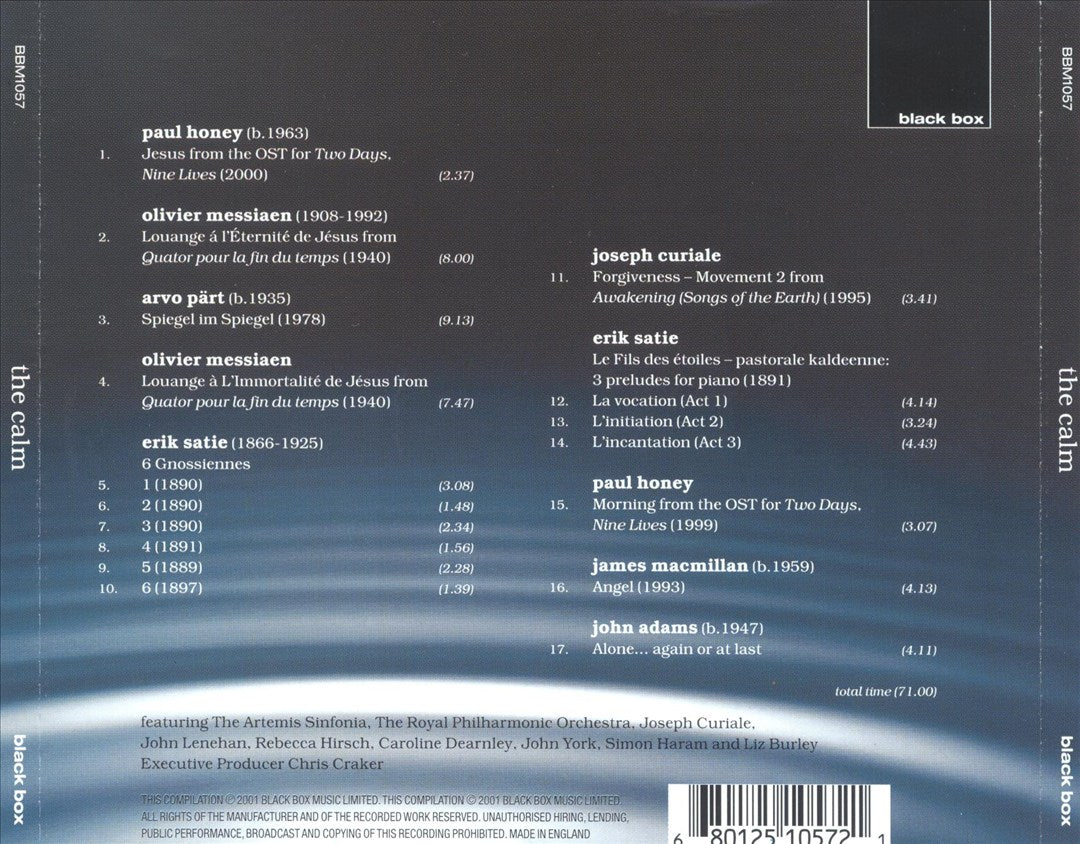
Personnel: Rebecca Hirsch (violin); Caroline Dearnley (cello); Simon Haram (saxophone); John York , John Lenehan (piano).
Recording information: Black Box Studio (01/23/1996-09/06/2000); CTS Studios, London, England (01/23/1996-09/06/2000); EMI Abbey Road Studios, London, England (01/23/1996-09/06/2000); Gateway Studio, Kingston, Jamaica (01/23/1996-09/06/2000).
Editor: Bill Sykes.
Unknown Contributor Role: Royal Philharmonic Orchestra.
Now this is a chill-out record. Forget all those loops of old hip-hop beats and dub records strung together with the sounds of babies laughing and chords from Eno's Music for Airports playing in a tunnel of fog and ice effects from some DJ's turntable. The Calm is the cure for the post-millennial... Just kidding -- sort of. The Calm is a selection of primarily 20th century classical works by composers such as Erik Satie (no the Trois Gymnopedies are not here), Olivier Messiaen, Arvo Pärt, John Adams, Joseph Curiale, James Macmillan, and Paul Honey, all of them based around personal notions of the sacred, the mystical or profound emotion expressed with calm and order. The recording opens with composer Paul Honey's "Jesus" (2000) a spiritual contemplation for chamber strings and horns. The work is reminiscent in its aching, longing beauty to Henrich Goréki's Symphony No. 3, though it lacks the darkness and sorrow. It is contrasted immediately with an eight-minute section of Messiaen's "Quartet for the End of Time" from 1940 with its devastatingly stark, beautiful, and poignant interplay between cello, violin, and piano. The section is also a reflection on Christ and his appearance at the end of time. Emotions are mixed in the work, as there is rejoicing among believers but sadness for those lost for eternity at the Second Coming. This is followed by the gorgeous "Spiegel in Spiegel" by Pärt, reflecting the early works of his tintinnabuli style of composition. Three notes played throughout and covered by a simple harmonic violin stating a lilting melody that has yearning at its heart, but also repose, knowing spare chords, appear at the end of the measures to offer consonance. And Messiaen returns with another section of the same work, restating the same reflection only a section later to create the ache and melancholy that seem so necessary in all honest human interactions with God.
As for the mysterious aspect of the program, we have two separate contributions by Erik Satie strategically placed in the running order: first the "Six Gnossiennes" written between 1890 and 1897. These are spare, haunting, and even hunted works in places. Their tempos vary little, their musical scope is purposefully narrow, and they look into the ether to search for who knows what. Their place is in the night, brooding, minimally foreboding, but without irony or despair. Satie's other contributions here are three preludes written during his period of examining the Rosicrucians, and they reflect the enigmatic sect's secrecy and love of ritual. Joseph Curiale's "Forgiveness" from 1995, the second movement from his Awakening cycle is in contrast almost searing, yet it has at its heart, the basis of calm, its emotions revealed and honest, but collected enough to express them beautifully. That said, this is an odd choice. Three other works close the album out, all minimal: another meditation on the spiritual for strings by Paul Honey (both his contributions are from the soundtrack to Two Days, Nine Lives), a minimal and thoroughly satisfying piano piece by James Macmillan entitled Angel from 1993, and the ubiquitous John Adams improvising on a wistful jazz theme from Errol Garner called "Alone" recorded specifically for this Black Box project. The Calm is an interesting, even provocative attempt to address something -- rather than cash in on it -- that has its roots in the unspeakable. Well done. ~ Thom Jurek
Recording information: Black Box Studio (01/23/1996-09/06/2000); CTS Studios, London, England (01/23/1996-09/06/2000); EMI Abbey Road Studios, London, England (01/23/1996-09/06/2000); Gateway Studio, Kingston, Jamaica (01/23/1996-09/06/2000).
Editor: Bill Sykes.
Unknown Contributor Role: Royal Philharmonic Orchestra.
Now this is a chill-out record. Forget all those loops of old hip-hop beats and dub records strung together with the sounds of babies laughing and chords from Eno's Music for Airports playing in a tunnel of fog and ice effects from some DJ's turntable. The Calm is the cure for the post-millennial... Just kidding -- sort of. The Calm is a selection of primarily 20th century classical works by composers such as Erik Satie (no the Trois Gymnopedies are not here), Olivier Messiaen, Arvo Pärt, John Adams, Joseph Curiale, James Macmillan, and Paul Honey, all of them based around personal notions of the sacred, the mystical or profound emotion expressed with calm and order. The recording opens with composer Paul Honey's "Jesus" (2000) a spiritual contemplation for chamber strings and horns. The work is reminiscent in its aching, longing beauty to Henrich Goréki's Symphony No. 3, though it lacks the darkness and sorrow. It is contrasted immediately with an eight-minute section of Messiaen's "Quartet for the End of Time" from 1940 with its devastatingly stark, beautiful, and poignant interplay between cello, violin, and piano. The section is also a reflection on Christ and his appearance at the end of time. Emotions are mixed in the work, as there is rejoicing among believers but sadness for those lost for eternity at the Second Coming. This is followed by the gorgeous "Spiegel in Spiegel" by Pärt, reflecting the early works of his tintinnabuli style of composition. Three notes played throughout and covered by a simple harmonic violin stating a lilting melody that has yearning at its heart, but also repose, knowing spare chords, appear at the end of the measures to offer consonance. And Messiaen returns with another section of the same work, restating the same reflection only a section later to create the ache and melancholy that seem so necessary in all honest human interactions with God.
As for the mysterious aspect of the program, we have two separate contributions by Erik Satie strategically placed in the running order: first the "Six Gnossiennes" written between 1890 and 1897. These are spare, haunting, and even hunted works in places. Their tempos vary little, their musical scope is purposefully narrow, and they look into the ether to search for who knows what. Their place is in the night, brooding, minimally foreboding, but without irony or despair. Satie's other contributions here are three preludes written during his period of examining the Rosicrucians, and they reflect the enigmatic sect's secrecy and love of ritual. Joseph Curiale's "Forgiveness" from 1995, the second movement from his Awakening cycle is in contrast almost searing, yet it has at its heart, the basis of calm, its emotions revealed and honest, but collected enough to express them beautifully. That said, this is an odd choice. Three other works close the album out, all minimal: another meditation on the spiritual for strings by Paul Honey (both his contributions are from the soundtrack to Two Days, Nine Lives), a minimal and thoroughly satisfying piano piece by James Macmillan entitled Angel from 1993, and the ubiquitous John Adams improvising on a wistful jazz theme from Errol Garner called "Alone" recorded specifically for this Black Box project. The Calm is an interesting, even provocative attempt to address something -- rather than cash in on it -- that has its roots in the unspeakable. Well done. ~ Thom Jurek
Tracks:
1 - Two Days, Nine Lives, film score~Jesus
2 - Quatuor pour la fin du temps, for violin, cello, clarinet & piano, I/22~Louange á l'Éternité de Jésus
3 - Spiegel im Spiegel, for violin & piano
4 - Quatuor pour la fin du temps, for violin, cello, clarinet & piano, I/22~Louange á l'Immortalité de Jésus
5 - Gnossiennes (6), for piano~Gnossiennes:1
6 - Gnossiennes (6), for piano~Gnossiennes:2
7 - Gnossiennes (6), for piano~Gnossiennes:3
8 - Gnossiennes (6), for piano~Gnossiennes:4
9 - Gnossiennes (6), for piano~Gnossiennes:5
10 - Gnossiennes (6), for piano~Gnossiennes:6
11 - Awakening (Songs of the Earth) for orchestra~Forgiveness
12 - fils des étoiles, Chaldean pastoral, 3 preludes for piano~No. 1, "Act I. La vocation"
13 - fils des étoiles, Chaldean pastoral, 3 preludes for piano~No. 2, "Act II. L'initiation" (The Initiation; The Lower Room of the Grand Temple)
14 - fils des étoiles, Chaldean pastoral, 3 preludes for piano~No. 3, "Act III. L'incantation" (The Incantation; The Terrace of Patesi - Priest-King, Goudea's Pal
15 - Two Days, Nine Lives, film score~Morning
16 - Angel, for piano
17 - I Was Looking at the Ceiling and Then I Saw the Sky, songplay~Alone ... again or at last, arranged for saxophone & piano
2 - Quatuor pour la fin du temps, for violin, cello, clarinet & piano, I/22~Louange á l'Éternité de Jésus
3 - Spiegel im Spiegel, for violin & piano
4 - Quatuor pour la fin du temps, for violin, cello, clarinet & piano, I/22~Louange á l'Immortalité de Jésus
5 - Gnossiennes (6), for piano~Gnossiennes:1
6 - Gnossiennes (6), for piano~Gnossiennes:2
7 - Gnossiennes (6), for piano~Gnossiennes:3
8 - Gnossiennes (6), for piano~Gnossiennes:4
9 - Gnossiennes (6), for piano~Gnossiennes:5
10 - Gnossiennes (6), for piano~Gnossiennes:6
11 - Awakening (Songs of the Earth) for orchestra~Forgiveness
12 - fils des étoiles, Chaldean pastoral, 3 preludes for piano~No. 1, "Act I. La vocation"
13 - fils des étoiles, Chaldean pastoral, 3 preludes for piano~No. 2, "Act II. L'initiation" (The Initiation; The Lower Room of the Grand Temple)
14 - fils des étoiles, Chaldean pastoral, 3 preludes for piano~No. 3, "Act III. L'incantation" (The Incantation; The Terrace of Patesi - Priest-King, Goudea's Pal
15 - Two Days, Nine Lives, film score~Morning
16 - Angel, for piano
17 - I Was Looking at the Ceiling and Then I Saw the Sky, songplay~Alone ... again or at last, arranged for saxophone & piano