

UPC: 752156013624
Format: CD
Release Date: Jul 12, 2000
Regular price
$15.95 USD
Regular price
Sale price
$15.95 USD
Unit price
per
Couldn't load pickup availability
FREE SHIPPING
This item is expected to ship between 4 and 10 business days after order placement.
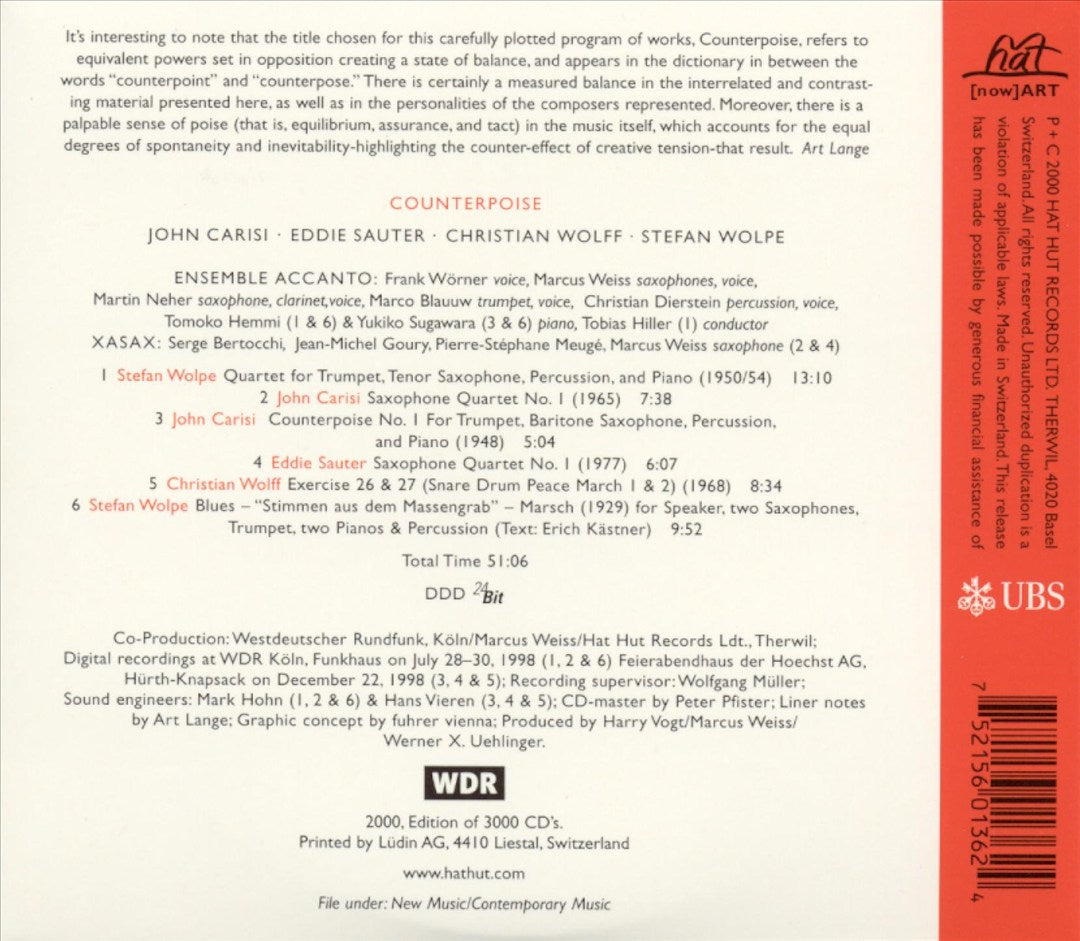
Liner Note Author: Art Lange.
Recording information: Feierabendhaus Der Hoechst AG (07/28/1998-12/22/1998); Hurth-Knapsack (07/28/1998-12/22/1998); WDR Koln, Funkhaus (07/28/1998-12/22/1998).
Performed by the Ensemble Accanto, the six jazz-inflected pieces constituting this collection are part of an attractive stylistic whole. Ranging in time across the 20th century from Stefan Wolpe's "Blues - "Stimmen Aus Dem Massengrab" - Marsch," composed in 1929, through Eddie Sauter's "Saxophone Quartet No. 1," which was written in 1977, there is a commonality traced to Wolpe's atonal, swinging beats, and raw harmonies that incorporate syncopated rhythms performed by trumpets, saxophones, and percussion, and an almost West Coast improvisatory feel. John Carisi (two of whose pieces are played) and Sauter are best known in the jazz world, but their primitive, crossover styles mesh well with Wolpe's two small group works and Christian Wolff's piece for snare drum solo ("Exercise 26 & 27 [Snare Drum Peace March 1 & 2]"). There is a subtle, if pleasing, balance between the ring of chamber-style restraint and the adventurous sounds that speak to dance-like euphoric modes. ~ Steven Loewy
Recording information: Feierabendhaus Der Hoechst AG (07/28/1998-12/22/1998); Hurth-Knapsack (07/28/1998-12/22/1998); WDR Koln, Funkhaus (07/28/1998-12/22/1998).
Performed by the Ensemble Accanto, the six jazz-inflected pieces constituting this collection are part of an attractive stylistic whole. Ranging in time across the 20th century from Stefan Wolpe's "Blues - "Stimmen Aus Dem Massengrab" - Marsch," composed in 1929, through Eddie Sauter's "Saxophone Quartet No. 1," which was written in 1977, there is a commonality traced to Wolpe's atonal, swinging beats, and raw harmonies that incorporate syncopated rhythms performed by trumpets, saxophones, and percussion, and an almost West Coast improvisatory feel. John Carisi (two of whose pieces are played) and Sauter are best known in the jazz world, but their primitive, crossover styles mesh well with Wolpe's two small group works and Christian Wolff's piece for snare drum solo ("Exercise 26 & 27 [Snare Drum Peace March 1 & 2]"). There is a subtle, if pleasing, balance between the ring of chamber-style restraint and the adventurous sounds that speak to dance-like euphoric modes. ~ Steven Loewy
Tracks:
1 - Quartet, for tenor saxophone, trumpet, percussion & piano, C. 122
2 - Saxophone Quartet No. 1
3 - Counterpoise No. 1 for trumpet, baritone saxophone, percussion & piano
4 - Saxophone Quartet No. 1
5 - Snare Drum Peace March, No. 1 & No. 2 (Exercise 26 & 27)
6 - Blues; Stimmen aus dem Massengrab; Marsch, for speaking chorus, 2 saxophones, trumpet, 2 pianos & percussion, C. 29
2 - Saxophone Quartet No. 1
3 - Counterpoise No. 1 for trumpet, baritone saxophone, percussion & piano
4 - Saxophone Quartet No. 1
5 - Snare Drum Peace March, No. 1 & No. 2 (Exercise 26 & 27)
6 - Blues; Stimmen aus dem Massengrab; Marsch, for speaking chorus, 2 saxophones, trumpet, 2 pianos & percussion, C. 29