

UPC: 794881679522
Format: CD
Release Date: Aug 05, 2002
Regular price
$21.95 USD
Regular price
Sale price
$21.95 USD
Unit price
per
Couldn't load pickup availability
FREE SHIPPING
This item is expected to ship between 4 and 6 business days after order placement.
Personnel: Pablo Garcia (drums).
Liner Note Author: Cyril Vincensini.
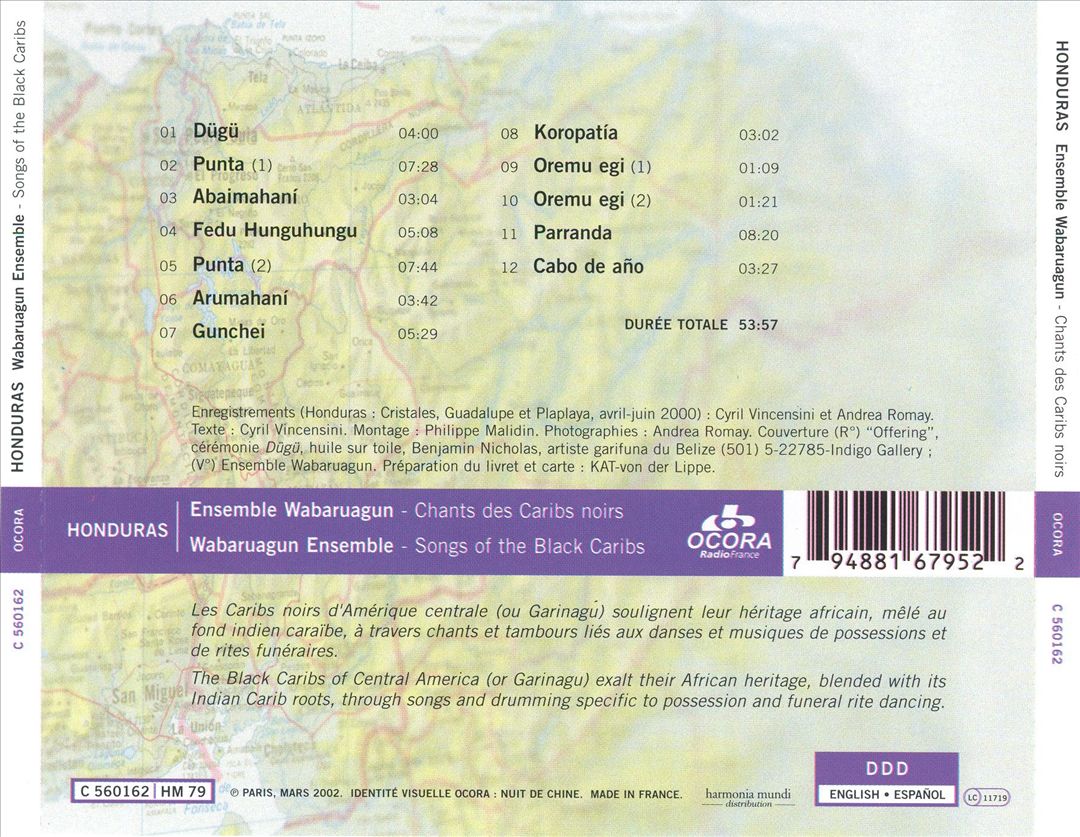
Recording information: Cristales, Honduras (04/2000-06/2000); Guadalupe, Honduras (04/2000-06/2000); Plaplaya, Honduras (04/2000-06/2000).
Translator: Martine Desbureaux.
Honduras: Songs of the Black Caribs is of prime interest to ethnomusicologists interested in noting the traditions of the Garifuna people. But with the rise of punta rock -- a descendant of Garifuna music -- on the world music scene, this makes for a fascinating roots record. It's a society, in Caribbean Central America, that was never assimilated by conquering whites, made up of escaped slaves. While they existed as essentially a separate society, keeping the African side of their nature very firmly alive, change and progress is seeing them become more integrated in 21st century society. It's notable that there's a separation of musical roles within the society -- women sing and dance, while the men play percussion instruments, the distinctive conch-shell horn, and occasionally sing. And much of the music concerns the same type of ancestor-oriented music found in religions that survived the West African diaspora. The Wabaruagan Ensemble do a wonderful job with this ritual and trance music, and the notes put everything in an honest, understandable perspective. ~ Chris Nickson
Liner Note Author: Cyril Vincensini.
Recording information: Cristales, Honduras (04/2000-06/2000); Guadalupe, Honduras (04/2000-06/2000); Plaplaya, Honduras (04/2000-06/2000).
Translator: Martine Desbureaux.
Honduras: Songs of the Black Caribs is of prime interest to ethnomusicologists interested in noting the traditions of the Garifuna people. But with the rise of punta rock -- a descendant of Garifuna music -- on the world music scene, this makes for a fascinating roots record. It's a society, in Caribbean Central America, that was never assimilated by conquering whites, made up of escaped slaves. While they existed as essentially a separate society, keeping the African side of their nature very firmly alive, change and progress is seeing them become more integrated in 21st century society. It's notable that there's a separation of musical roles within the society -- women sing and dance, while the men play percussion instruments, the distinctive conch-shell horn, and occasionally sing. And much of the music concerns the same type of ancestor-oriented music found in religions that survived the West African diaspora. The Wabaruagan Ensemble do a wonderful job with this ritual and trance music, and the notes put everything in an honest, understandable perspective. ~ Chris Nickson
Tracks:
1 - Dügü
2 - Punta
3 - Abaimahaní
4 - Fedu Hunguhungu
5 - Punta
6 - Arumahaní
7 - Gunchei
8 - Koropatia
9 - Oremu Egi
10 - Oremu Egi
11 - Parranda
12 - Cabo de Año
2 - Punta
3 - Abaimahaní
4 - Fedu Hunguhungu
5 - Punta
6 - Arumahaní
7 - Gunchei
8 - Koropatia
9 - Oremu Egi
10 - Oremu Egi
11 - Parranda
12 - Cabo de Año