

Various Artists
Music of Uzbekistan: Field Recordings By Deben Bhattacharya
Music of Uzbekistan: Field Recordings By Deben Bhattacharya
UPC: 5019396243828
Format: CD
Release Date: Feb 25, 2013
Regular price
$24.95 USD
Regular price
Sale price
$24.95 USD
Unit price
per
Couldn't load pickup availability
FREE SHIPPING
This item is currently out of stock and may be on backorder.
Liner Note Authors: Diz Heller; Jharna Bose Bhattacharya.
Photographer: Deben Bhattacharya.
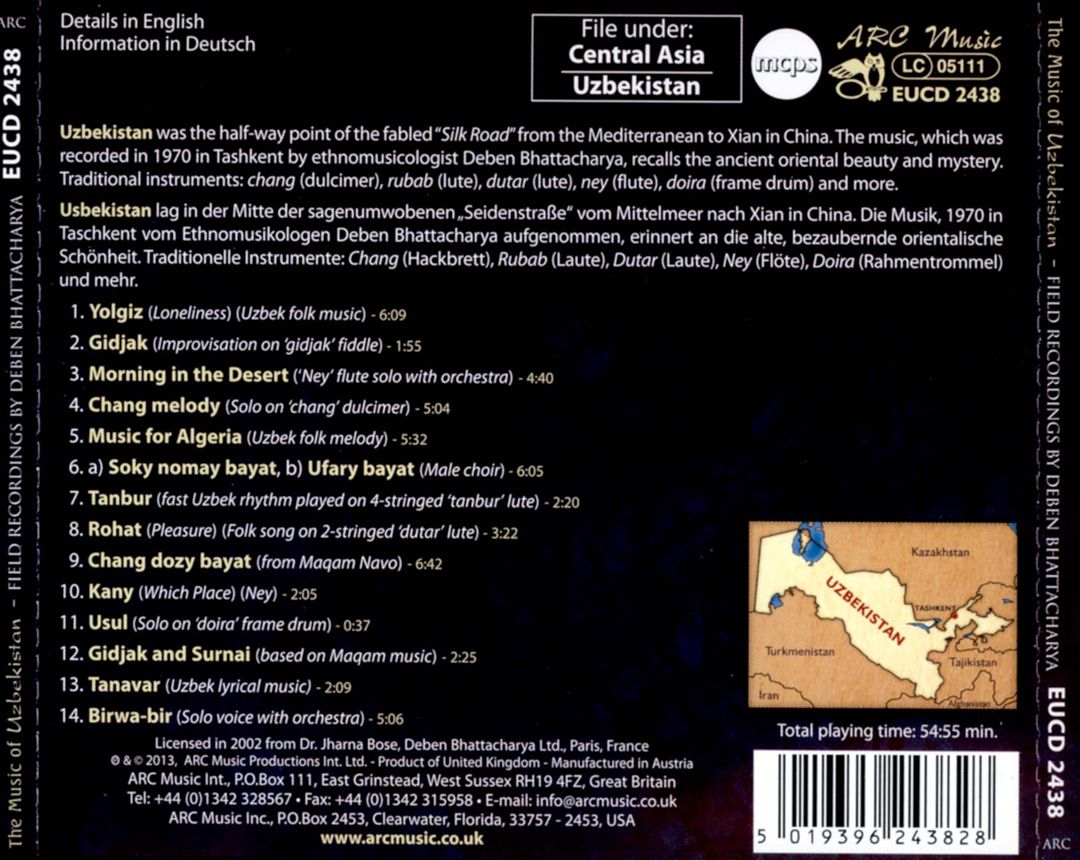
An album culled from the recordings made by the late ethnomusicologist Deben Bhattacharya during a trip to Uzbekistan in 1970, while it was still under Soviet rule. Luckily for the cultural aspects of the old central Asian power, the Soviet hold on culture was relatively weak in Uzbekistan, so much of the culture survived decently. Here, the primary form of music is that based on the Middle Eastern maqam system, though there are aspects of a number of local folk forms as well. Instrumentation hails from the full area of influence of the Silk Road routes, with the bulk of the instruments having Persian origin (but occasionally Chinese- or Indian-based names) and others coming from Russia in the north, or locally. The songs take one of two directions vocally: the first being a male chorus similar in many ways to the Bosnian Muslim chant groups, and the second being a contemporary solo form with orchestral accompaniment, popular in the Middle East. The album overall holds many parallels with surrounding cultures, but puts its own flavor into each composition in subtle ways. Pick it up for a listen to the musical culture of one of the historical powerhouses of Central Asia which is often overlooked. ~ Adam Greenberg
Photographer: Deben Bhattacharya.
An album culled from the recordings made by the late ethnomusicologist Deben Bhattacharya during a trip to Uzbekistan in 1970, while it was still under Soviet rule. Luckily for the cultural aspects of the old central Asian power, the Soviet hold on culture was relatively weak in Uzbekistan, so much of the culture survived decently. Here, the primary form of music is that based on the Middle Eastern maqam system, though there are aspects of a number of local folk forms as well. Instrumentation hails from the full area of influence of the Silk Road routes, with the bulk of the instruments having Persian origin (but occasionally Chinese- or Indian-based names) and others coming from Russia in the north, or locally. The songs take one of two directions vocally: the first being a male chorus similar in many ways to the Bosnian Muslim chant groups, and the second being a contemporary solo form with orchestral accompaniment, popular in the Middle East. The album overall holds many parallels with surrounding cultures, but puts its own flavor into each composition in subtle ways. Pick it up for a listen to the musical culture of one of the historical powerhouses of Central Asia which is often overlooked. ~ Adam Greenberg
Tracks:
1 - Yolgiz [Loneliness]
2 - Gidjak
3 - Morning in the Desert
4 - Chang Melody
5 - Music for Algeria
6 - Soky Nomay Bayat/Ufary Bayat
7 - Tanbur
8 - Rohat [Pleasure]
9 - Chang Dozy Bayat
10 - Kany [Which Place]
11 - Usul
12 - Gidjak and Surnai
13 - Tanavar
14 - Birwa-Bir
2 - Gidjak
3 - Morning in the Desert
4 - Chang Melody
5 - Music for Algeria
6 - Soky Nomay Bayat/Ufary Bayat
7 - Tanbur
8 - Rohat [Pleasure]
9 - Chang Dozy Bayat
10 - Kany [Which Place]
11 - Usul
12 - Gidjak and Surnai
13 - Tanavar
14 - Birwa-Bir