

UPC: 3567255626821
Format: CD
Release Date: Sep 19, 2011
Regular price
$10.95 USD
Regular price
Sale price
$10.95 USD
Unit price
per
Couldn't load pickup availability
FREE SHIPPING
This item is expected to ship between 3 and 6 business days after order placement.
Personnel: Sia Tolno (vocals, background vocals); Mamadou Camara (guitar); Papa Kouyate (congas); François Bréant (cuica, cymbals, guiro, maracas, shaker, triangle, percussion, bells); Mabinté Camara, Alice Kamanou (background vocals).
Audio Mixer: Stéphane Caisson.
Recording information: Mory Kante Studio, Conakry; Studio Do Soul, Paris.
Photographer: N'krumah Lawson-Daku.
Arranger: François Bréant.
Make no mistake: suffering does not have to result in great art. It can result in really lousy art. But it's also true that in the hands of a great artist, suffering can be simultaneously expressed and transcended, and Sierra Leonian singer Sia Tolno has achieved the delicate balance between self-expression and universal uplift that alone is capable of creating that kind of magical result. Drawing on her experiences as a victim of abuse, economic privation, and exile, she has written a set of songs that depict her trials without flinching, but that focus on her joy at having emerged from them. Opening with the rhythmically complex and soaringly beautiful "Blamah Blamah," Tolno sets the stage for the rest of the album: her sweetly rough-edged voice will be answered by densely harmonized female backing vocals and supported by instrumental accompaniment that draws alternately on Congolese rumba rhythms, desert blues, and European dance patterns; the lyrics will alternate between Creole and standard English. At its best, the music is hypnotically funky ("Blamah Blamah," "Odju Watcha") or smokily sad ("Di Ya Leh," "Malaya") or jazzy ("Ayiboh") or even reggae-based (the lovely "Kongossa"). When not at its best it can get a bit tedious ("Polli Polli," which is way too long for a one-chord composition), but even when not at its best, Sia Tolno's music is consistently attractive. ~ Rick Anderson
Audio Mixer: Stéphane Caisson.
Recording information: Mory Kante Studio, Conakry; Studio Do Soul, Paris.
Photographer: N'krumah Lawson-Daku.
Arranger: François Bréant.
Make no mistake: suffering does not have to result in great art. It can result in really lousy art. But it's also true that in the hands of a great artist, suffering can be simultaneously expressed and transcended, and Sierra Leonian singer Sia Tolno has achieved the delicate balance between self-expression and universal uplift that alone is capable of creating that kind of magical result. Drawing on her experiences as a victim of abuse, economic privation, and exile, she has written a set of songs that depict her trials without flinching, but that focus on her joy at having emerged from them. Opening with the rhythmically complex and soaringly beautiful "Blamah Blamah," Tolno sets the stage for the rest of the album: her sweetly rough-edged voice will be answered by densely harmonized female backing vocals and supported by instrumental accompaniment that draws alternately on Congolese rumba rhythms, desert blues, and European dance patterns; the lyrics will alternate between Creole and standard English. At its best, the music is hypnotically funky ("Blamah Blamah," "Odju Watcha") or smokily sad ("Di Ya Leh," "Malaya") or jazzy ("Ayiboh") or even reggae-based (the lovely "Kongossa"). When not at its best it can get a bit tedious ("Polli Polli," which is way too long for a one-chord composition), but even when not at its best, Sia Tolno's music is consistently attractive. ~ Rick Anderson
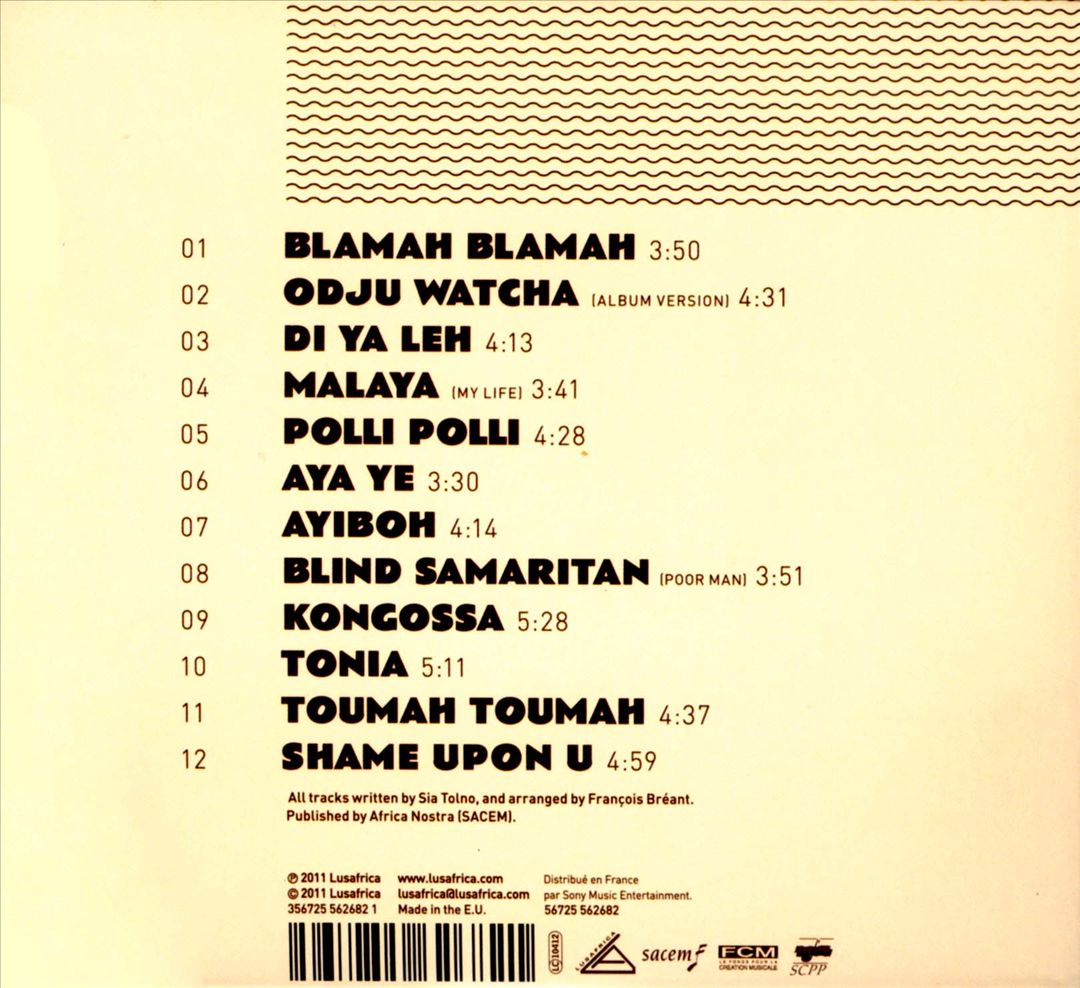
Tracks:
1 - Blamah Blamah
2 - Odju Watcha [Album Version]
3 - Di Ya Leh
4 - Malaya [My Life]
5 - Polli Polli
6 - Aya Ye
7 - Ayiboh
8 - Blind Samaritan (Poor Man)
9 - Kongossa
10 - Tonia
11 - Toumah Toumah
12 - Shame Upon U
2 - Odju Watcha [Album Version]
3 - Di Ya Leh
4 - Malaya [My Life]
5 - Polli Polli
6 - Aya Ye
7 - Ayiboh
8 - Blind Samaritan (Poor Man)
9 - Kongossa
10 - Tonia
11 - Toumah Toumah
12 - Shame Upon U