

UPC: 013711320725
Format: CD
Release Date: Feb 27, 2001
Regular price
$12.95 USD
Regular price
Sale price
$12.95 USD
Unit price
per
Couldn't load pickup availability
FREE SHIPPING
This item is expected to ship between 2 and 3 business days after order placement.
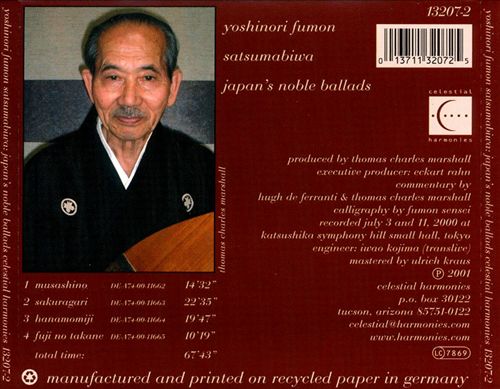
Solo performer: Yosinori Fumon.
Recorded at Katsushika Symphony Hill, Tokyo, Japan from July 3-11, 2000. Includes liner notes by Hugh De Ferranti and Charles Marshall.
Recording information: Katsuskika Symphony Hill Sall Hall, Tikyo.
Satsumabiwa, the Japanese ballad form, is very different from the Western idea of ballads. The texts are sung/recited, and accompanied on the biwa, a lute-like instrument. However, it's not accompaniment in the standard Western sense. The instrument plays in preludes and adds injections and phrases around the text, meaning the playing and vocal work are essentially separate, although done by one person. Satsumabiwa began in the mid-16th century, although the "modern" style, which is what's played here, began in the 1880s, as part of a regional style in Kagoshima. Essentially, this stands as an illustration of style, with "Musashino," a song that teaches a moral lesson, attributed to 16th century philosopher Shimazu Tadanaga. "Sakuragari" dates from the 1880s, and "Hanamomiji" comes from an unknown source, although it shows most of the musical sections of true Satsumabiwa music: the kuzure, shigin, gingawari, and motogin. All that's missing -- but is there in the other pieces -- is the waka. The disc closes with "Fuji No Takane," a poem about Mt. Fuji by Yamambe no Akahito. While superbly performed by Yoshinori Fumon, it's definitely not easy listening for most Western ears. Not only is the form vastly different, but the scales and languages add extra barriers. But as a glimpse into something not often heard outside Japan, this is fascinating. The informative booklet, which includes translations of the lyrics, helps a great deal, too. So, while it's not for everyone, as a piece of a musical education, it's excellent. ~ Chris Nickson
Recorded at Katsushika Symphony Hill, Tokyo, Japan from July 3-11, 2000. Includes liner notes by Hugh De Ferranti and Charles Marshall.
Recording information: Katsuskika Symphony Hill Sall Hall, Tikyo.
Satsumabiwa, the Japanese ballad form, is very different from the Western idea of ballads. The texts are sung/recited, and accompanied on the biwa, a lute-like instrument. However, it's not accompaniment in the standard Western sense. The instrument plays in preludes and adds injections and phrases around the text, meaning the playing and vocal work are essentially separate, although done by one person. Satsumabiwa began in the mid-16th century, although the "modern" style, which is what's played here, began in the 1880s, as part of a regional style in Kagoshima. Essentially, this stands as an illustration of style, with "Musashino," a song that teaches a moral lesson, attributed to 16th century philosopher Shimazu Tadanaga. "Sakuragari" dates from the 1880s, and "Hanamomiji" comes from an unknown source, although it shows most of the musical sections of true Satsumabiwa music: the kuzure, shigin, gingawari, and motogin. All that's missing -- but is there in the other pieces -- is the waka. The disc closes with "Fuji No Takane," a poem about Mt. Fuji by Yamambe no Akahito. While superbly performed by Yoshinori Fumon, it's definitely not easy listening for most Western ears. Not only is the form vastly different, but the scales and languages add extra barriers. But as a glimpse into something not often heard outside Japan, this is fascinating. The informative booklet, which includes translations of the lyrics, helps a great deal, too. So, while it's not for everyone, as a piece of a musical education, it's excellent. ~ Chris Nickson
Tracks:
1 - Musashino
2 - Sakuragari (Cherry Blossom Hunting)
3 - Hanamomiji (Maple Leaf Flowers)
4 - Fuji No Takane (Fuji's Lofty Peak)
2 - Sakuragari (Cherry Blossom Hunting)
3 - Hanamomiji (Maple Leaf Flowers)
4 - Fuji No Takane (Fuji's Lofty Peak)