

Various Artists
Soul of a Nation: Afro-Centric Visions in the Age of Black Power - Underground Jazz, Street Funk & the Roots of Rap 1968-79
Soul of a Nation: Afro-Centric Visions in the Age of Black Power - Underground Jazz, Street Funk & the Roots of Rap 1968-79
UPC: 5026328103938
Format: CD
Release Date: Aug 04, 2017
Regular price
$19.95 USD
Regular price
Sale price
$19.95 USD
Unit price
per
Couldn't load pickup availability
FREE SHIPPING
This item is expected to ship between 4 and 6 business days after order placement.
Photographers: David Fenton; Deborah Feingold; Robert a. Sengstacke; Jack Garofalo.
In the '60s, American music and culture were going through profound changes, and the seismic shifts in both politics and the arts were felt especially strongly in the African-American community. The twin phenomena of psychedelia and youth in revolt shifted the axis for rock & roll, but in many respects the call for revolution had an even deeper impact in soul, R&B, and jazz. Just as demands for radical change had been simmering in the black community long before the tumult of the '60s put them on the 6 o'clock news, black music and art potently reflected the evolution of the Black Power movement from Martin Luther King's nonviolent protest to the more militant approach of Malcolm X and the Black Panther Party. Soul of a Nation: Afro-Centric Visions in the Age of Black Power - Underground Jazz, Street Funk & the Roots of Rap 1968-79 is a compilation of material recorded during the height of the Black Power movement and in the years of its aftermath, created as a companion piece to an exhibit of art and artifacts of the era presented at London's Tate Modern Gallery. As the subtitle suggests, from the recitational style of Gil Scott-Heron, David McKnight, and Duke Edwards to the circular rhythmic constructs of Mandingo Griot Society and Oneness of Juju, much of the bold experimentalism of this music would later make its way into the sound and frameworks of conscious hip-hop in the '80s and '90s. But the passion, poetry, and articulate energy in these 13 tracks are unique to their era, and the Afrocentric viewpoint of this music is expressed in both music and lyrics, as African rhythms inform the performances in sinewy funk as well as more cerebral and pathbreaking jazz. A substantive box set could be assembled from this period and these influences, but for anyone curious about how the rise of the Black Power movement influenced the arts -- and vice versa -- Soul of a Nation is a superb and thought-provoking introduction. ~ Mark Deming
In the '60s, American music and culture were going through profound changes, and the seismic shifts in both politics and the arts were felt especially strongly in the African-American community. The twin phenomena of psychedelia and youth in revolt shifted the axis for rock & roll, but in many respects the call for revolution had an even deeper impact in soul, R&B, and jazz. Just as demands for radical change had been simmering in the black community long before the tumult of the '60s put them on the 6 o'clock news, black music and art potently reflected the evolution of the Black Power movement from Martin Luther King's nonviolent protest to the more militant approach of Malcolm X and the Black Panther Party. Soul of a Nation: Afro-Centric Visions in the Age of Black Power - Underground Jazz, Street Funk & the Roots of Rap 1968-79 is a compilation of material recorded during the height of the Black Power movement and in the years of its aftermath, created as a companion piece to an exhibit of art and artifacts of the era presented at London's Tate Modern Gallery. As the subtitle suggests, from the recitational style of Gil Scott-Heron, David McKnight, and Duke Edwards to the circular rhythmic constructs of Mandingo Griot Society and Oneness of Juju, much of the bold experimentalism of this music would later make its way into the sound and frameworks of conscious hip-hop in the '80s and '90s. But the passion, poetry, and articulate energy in these 13 tracks are unique to their era, and the Afrocentric viewpoint of this music is expressed in both music and lyrics, as African rhythms inform the performances in sinewy funk as well as more cerebral and pathbreaking jazz. A substantive box set could be assembled from this period and these influences, but for anyone curious about how the rise of the Black Power movement influenced the arts -- and vice versa -- Soul of a Nation is a superb and thought-provoking introduction. ~ Mark Deming
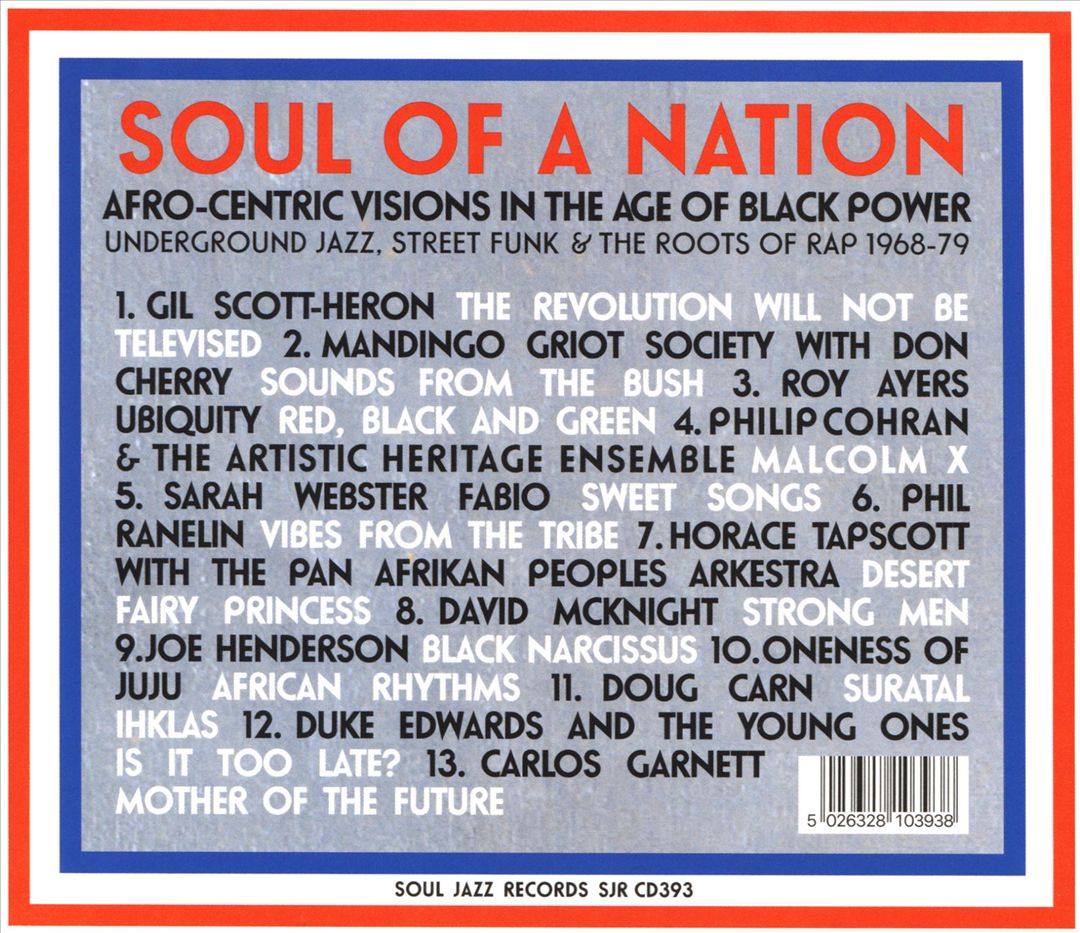
Tracks:
1 - Revolution Will Not Be Televised
2 - Sounds From the Bush
3 - Red, Black and Green
4 - Malcolm X
5 - Sweet Songs
6 - Vibes From the Tribe
7 - Desert Fairy Princess
8 - Strong Men
9 - Black Narcissus
10 - African Rhythms
11 - Suratal Ihklas
12 - Is It Too Late?
13 - Mother of the Future
2 - Sounds From the Bush
3 - Red, Black and Green
4 - Malcolm X
5 - Sweet Songs
6 - Vibes From the Tribe
7 - Desert Fairy Princess
8 - Strong Men
9 - Black Narcissus
10 - African Rhythms
11 - Suratal Ihklas
12 - Is It Too Late?
13 - Mother of the Future