

UPC: 657036118720
Format: CD
Release Date: May 22, 2012
Regular price
$12.95 USD
Regular price
Sale price
$12.95 USD
Unit price
per
Couldn't load pickup availability
FREE SHIPPING
This item is expected to ship between 3 and 5 business days after order placement.
Personnel: Naser Musa (vocals, oud); Ulas Özdemir (vocals, saz); Habib Meftah Boushehri (vocals, flute, percussion); Azam Ali (vocals, percussion); Loga Ramin Torkian (guitar, saz, viol); Carmen Rizzo (keyboards, drums, percussion, electronics); Alex Bellegarde (upright bass); Omer Avci (percussion).
Audio Mixer: Carmen Rizzo.
Liner Note Authors: Azam Ali; Niyaz.
Recording information: Istanbul, Turkey; Montreal, Quebec.
Photographers: Raymond Van Tassel; Laura Arwen Berg.
Arranger: Niyaz.
For those who have grown up with Western pop music and who don't speak Arabic (or Persian or Turkish), the temptation when listening to a Niyaz album is simply to sit back and let the sinuous grooves and "exotic" melodies wash over you in a state of blissful Orientalist incomprehension. But that's always been a good way to miss a significant part of what this band is doing. While the lyrical themes of their first two albums have focused mainly on issues related to Iranians in exile around the world, their third, titled Sumud (Steadfastness) deals with broader issues of cultural diaspora and ethnic minority status. The program draws on Kurdish, Turkish, Afghani, and Palestinian material as well as folk songs from Iran; some of the songs are traditional folk music, while others are settings of secular and mystical poems from the 11th to the 17th centuries. For the most part, the songs are not directly political; instead, they tend to address predictable themes of love and longing, cultural tolerance, suffering as a shared experience, and endurance. But for those with ears to hear, there are subtle messages about the ultimate ineffectuality of borders, the implications of universal experience, and cultural resistance. If you are uninterested in such messages, there is still the option of sitting back and letting Ali's gorgeous voice and the band's tough, dark, powerful grooves carry you away. ~ Rick Anderson
Audio Mixer: Carmen Rizzo.
Liner Note Authors: Azam Ali; Niyaz.
Recording information: Istanbul, Turkey; Montreal, Quebec.
Photographers: Raymond Van Tassel; Laura Arwen Berg.
Arranger: Niyaz.
For those who have grown up with Western pop music and who don't speak Arabic (or Persian or Turkish), the temptation when listening to a Niyaz album is simply to sit back and let the sinuous grooves and "exotic" melodies wash over you in a state of blissful Orientalist incomprehension. But that's always been a good way to miss a significant part of what this band is doing. While the lyrical themes of their first two albums have focused mainly on issues related to Iranians in exile around the world, their third, titled Sumud (Steadfastness) deals with broader issues of cultural diaspora and ethnic minority status. The program draws on Kurdish, Turkish, Afghani, and Palestinian material as well as folk songs from Iran; some of the songs are traditional folk music, while others are settings of secular and mystical poems from the 11th to the 17th centuries. For the most part, the songs are not directly political; instead, they tend to address predictable themes of love and longing, cultural tolerance, suffering as a shared experience, and endurance. But for those with ears to hear, there are subtle messages about the ultimate ineffectuality of borders, the implications of universal experience, and cultural resistance. If you are uninterested in such messages, there is still the option of sitting back and letting Ali's gorgeous voice and the band's tough, dark, powerful grooves carry you away. ~ Rick Anderson
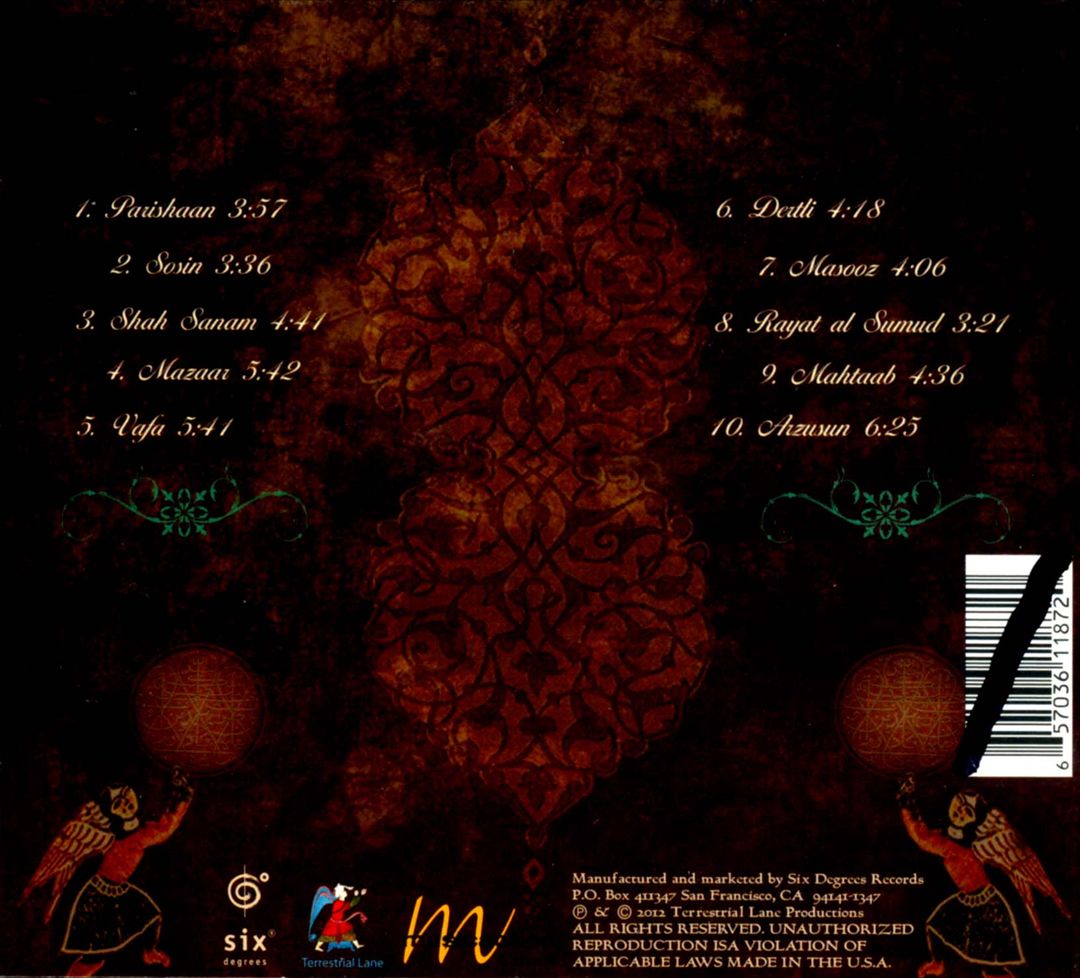
Tracks:
1 - Parishaan
2 - Sosin
3 - Shah Sanam
4 - Mazaar
5 - Vafa
6 - Dertli
7 - Masooz
8 - Rayat al Sumud
9 - Mahtaab
10 - Arzusun
2 - Sosin
3 - Shah Sanam
4 - Mazaar
5 - Vafa
6 - Dertli
7 - Masooz
8 - Rayat al Sumud
9 - Mahtaab
10 - Arzusun